

A media plan sets out which media a brand will use, to reach whom, when, with what share of budget and which KPIs, so that a campaign reaches its goal. For out-of-home media, the simplest place to start is four questions before the brief: who will see it, what will they feel, what will they do next, and what will we learn.
The question matters more each year. MAAT’s 2026 Media Industry Update (31 March 2026) reports that Thai out-of-home media (outdoor + transit) grew 13.5% in 2025 to 17.7% of ad spend, with a forecast of 19.6% in 2026. As more money moves into OOH, giving every baht a clear job becomes essential.
A media plan is the output of media planning. Planning starts from the business problem, turns it into a communication goal, chooses suitable media and then sequences timing and budget. Once everyone agrees, the result is written into a table: the media plan used to brief, buy and track.
A good plan differs from a quotation because it answers “why”, not just “what”: why taxi screens in week one, why an activation in week three, and which KPI each medium owns. A reason on every line lets the team adjust mid-flight without losing direction.
OOH planning differs from online planning because it mixes media bought by time and place, media that must be produced and installed, and activations that need people on site. The plan has to include production lead time, permits and agreed measurement in one document.
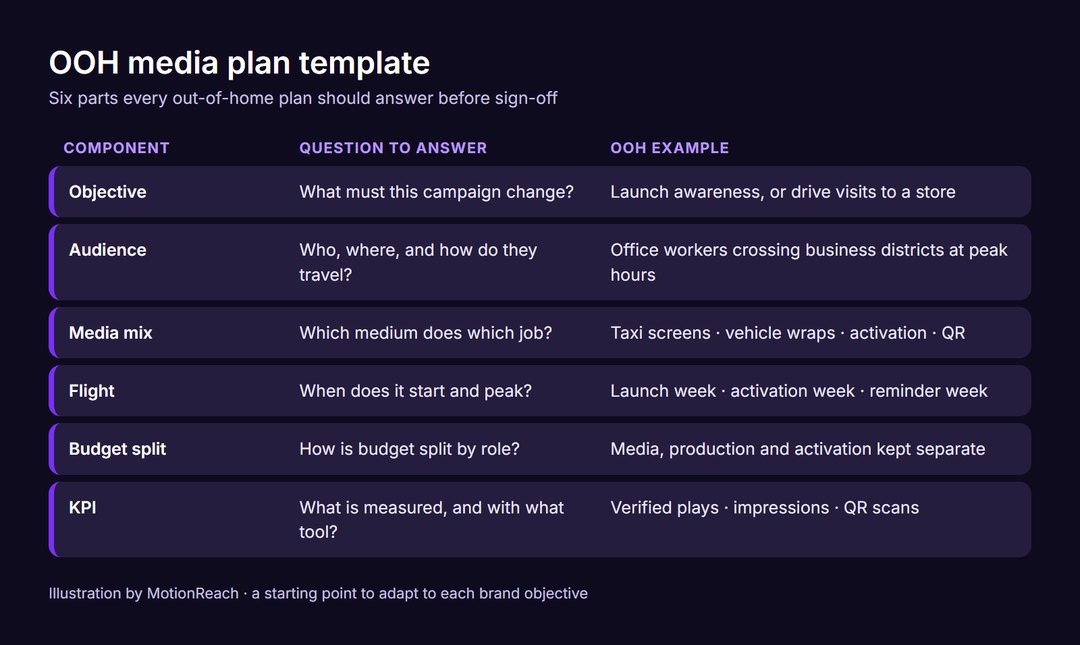
A workable out-of-home plan has six parts. This table works as a starter media plan template.
| Component | Question to answer | OOH example |
|---|---|---|
| Objective | What must this campaign change? | Launch awareness, or drive visits to a store |
| Audience | Who, where, and how do they travel? | Office workers crossing business districts at peak hours |
| Media mix | Which medium does which job? | Taxi screens, vehicle wraps, activation, QR |
| Flight | When does it start and peak? | Launch week, activation week, reminder week |
| Budget split | How is budget split by role? | Media, production and activation kept separate |
| KPI | What is measured, and with what tool? | Verified plays, impressions, QR scans |
Start from what the business needs, then pick one main communication goal, such as awareness, trial or store visits. Plans with several equal goals usually end up with none that is clear.
OOH sells place and time, so describe the audience by travel behaviour, not just age and income: which districts, which modes of transport, and which hours on the road.
Give each medium one clear role: wraps for broad visibility, in-car screens for area and time targeting, activations for trial. Then lay them out as flights and split budget by role, always separating media from production. Browse the out of home advertising formats available in Bangkok to support these choices.
OOH KPIs work best at three levels: Delivery (did it run), Exposure (how many had the chance to see it) and Response (who acted). Name the tool for each, such as play logs, impressions modelled from plays, or QR scans.
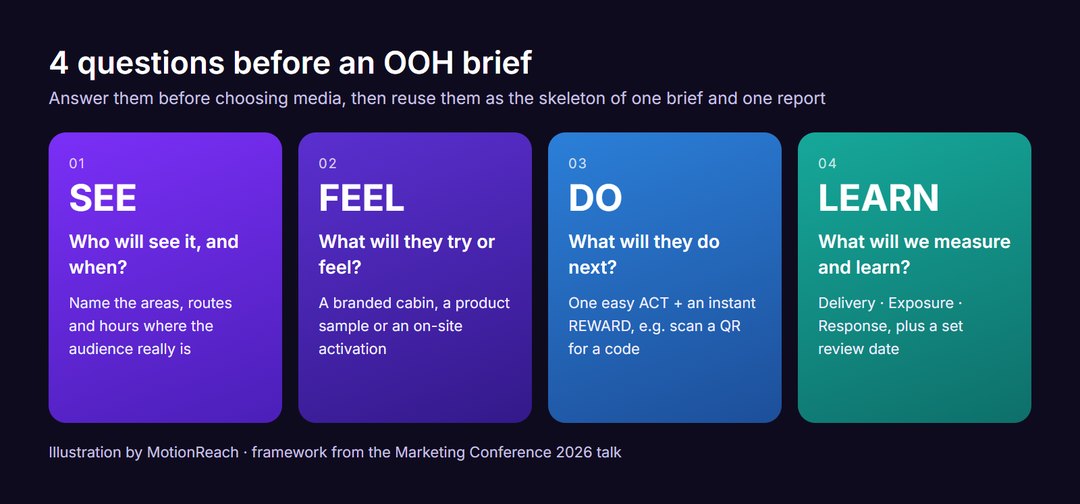
At Marketing Conference 2026, the MotionReach founder described a common problem: one campaign split across a media owner, an event agency and a digital agency becomes three briefs, three timelines and three reports, and nobody captures the lessons for next time. SEE · FEEL · DO · LEARN was proposed as four questions to answer before writing the brief.
Heavy traffic is not the same as the right people. Name the areas, routes and hours where the audience is, for example in-cabin screens targeted by zone and time, or wraps on vehicles that pass the target districts. The OTP Travel Demand Survey (Nov 2021–Mar 2022) puts the average taxi and Grab trip at 28 minutes, so passengers spend longer with in-car media than drivers do with a roadside board. See taxi advertising for details.
OOH does not have to stop at being seen. A branded cabin, a sampling tray, a roadshow or sampling event lets people touch the product. This question decides whether the campaign needs an experience layer and how much production time to allow. See experiential marketing for examples.
Design a next step people want to take, such as a QR code to a microsite, a game, a quiz or a discount code. The rule that works across media is ACT, one simple action, plus REWARD, something immediate. If this question has no answer, the campaign can only be measured at the exposure level.
Agree the three levels of measurement in the brief, from verified plays and modelled impressions to scans and follow-up actions, and set a review date. Knowing where, when and what worked is the brief for the next campaign.
With all four answered, the team can write one brief that covers media, production, activation and measurement, and get one report that reads from exposure through to action.
This is a hypothetical example, not a real client campaign, and it has no prices. A skincare brand launches a new product in Bangkok and wants office workers in business districts to know it, try it and take a discount code to buy online. The plan runs over four weeks using SEE · FEEL · DO · LEARN.
| Week | Main role | Media and activity | Key condition | KPI tracked |
|---|---|---|---|---|
| Week 1 | SEE launch | Bus wrap + taxi screens | In-car screens on business-district routes at peak hours | Verified plays · impressions |
| Week 2 | SEE + DO | Taxi screens with QR + taxi wrap | QR creative leads to a microsite code | Scans · microsite visits |
| Week 3 | FEEL | Activation / roadshow with samples | Held in the same district as the screen routes | Participants · codes claimed |
| Week 4 | DO + LEARN | Taxi screens repeat the discount code | Weighted to the hours with most scans in week 2 | Code redemptions · lessons learned |
Each week has one main role, the media answer that role, and the KPI matches what each medium can deliver. Week four uses week-two data to shift timing: learning during the campaign, not after it. In a real plan, split budget by each week’s role and keep media, production and activation costs separate.
Checklist before the plan goes for approval:
The plan adapts to other formats, for example swapping the bus wrap for special media, or adding roadside screens from dooh bangkok when the objective needs wider visibility. MotionReach plans and sources the media and coordinates production, activation and reporting in one team.
A media plan decides which media, for whom, when and what to measure. Media buying is booking and purchasing the media in that plan. The plan always comes first.
Media planning is the whole thinking and analysis process. The media plan is the resulting document that sums up media, timing, budget and KPIs in a table.
Use three levels: Delivery, such as verified plays; Exposure, such as impressions and reach, which are estimates; and Response, such as QR scans, codes claimed or event participation.
Use the six-part table and the four-week flight example in this article as a starting point, then adjust media and KPIs to the brand objective.
Answer SEE · FEEL · DO · LEARN first, then choose media, timing and budget. The four answers become the skeleton of both the brief and the report.
Send one brief and get the media plan, production, activation and report from one team. Contact MotionReach to start planning your out-of-home campaign.
Sources: MAAT (Media Agency Association of Thailand) 2026 Media Industry Update, 31 March 2026 · OTP Travel Demand Survey (Nov 2021–Mar 2022). The flight table is a hypothetical example.