

What is digital signage? It is a screen that a venue owner installs to talk to people already inside its own space, such as menus, promotions or wayfinding. DOOH (digital out-of-home) is advertising media that sells airtime to many brands so they can reach people on the street and on the move.
Both use similar screens and back-end software, so the terms are often mixed up. They differ in who owns the screen, who watches it and how it makes money. This article compares the two side by side, explains the role of the CMS, and shows when a brand should step outside its own screens into out-of-home media, based on how the MotionReach team runs an in-vehicle screen network and plans digital out-of-home in Bangkok.
Digital signage replaces printed signs with LCD or LED screens that can change at any time. You see it in restaurants, retail stores, banks, hospitals, office lobbies and factories. Its main job is to talk to people who are already on site: recommend a menu item, show a queue number or prompt an add-on purchase at the till.
A digital signage system has three parts: the screen, a media player and content management software (CMS) used to upload creative, set schedules and change content centrally. A chain can update promotions in every branch at once without printing new signs.
The limit is the audience. In-store screens only reach people who have already walked in, so they are good at raising basket size but do little to bring in new customers who do not know the brand yet.
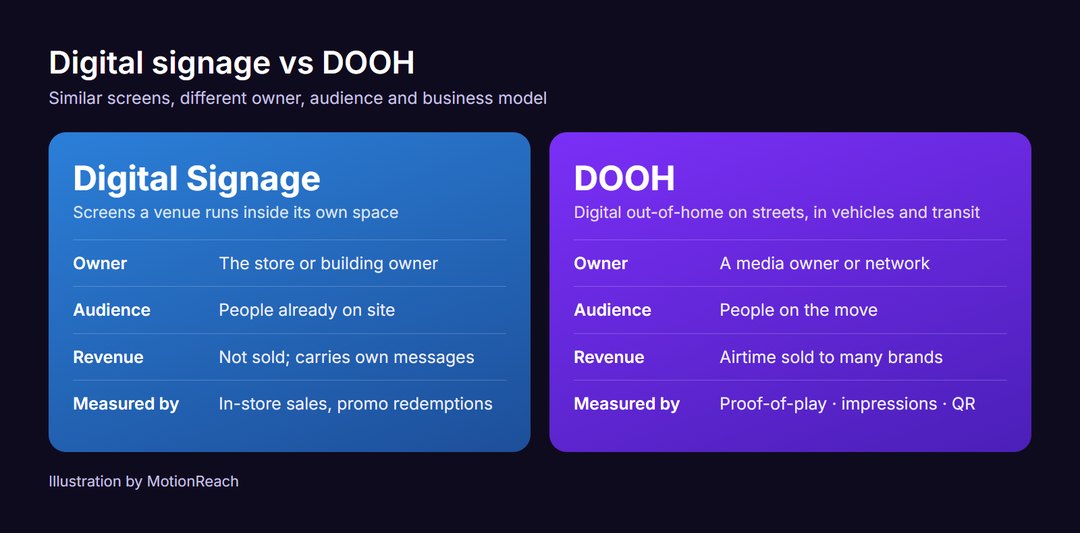
The most important difference comes down to one question: who owns the screen, and who pays for a message to appear on it? The table below sums up four dimensions that drive the decision.
| Dimension | Digital signage | DOOH |
|---|---|---|
| Screen owner | The store or building owner | A media owner or media network |
| Audience | Customers already on site | The public on streets, in vehicles and in transit |
| Business model | Not sold; carries the owner’s own messages | Airtime (slots) sold to many brands |
| Measurement | In-store sales, promo redemptions | Proof-of-play, impressions, reach, QR scans |
| Main goal | Raise basket size, inform | Build awareness, bring new people to the brand |
Digital is now the mainstream of out-of-home. The WOO 2026 Global Out of Home Expenditure Report (July 2026) puts global out-of-home spend in 2025 at US$54.2 billion, with 47.1% of it on DOOH, and out-of-home as a whole at 5.1% of global advertising.
Put simply, digital signage is a tool for the venue owner, while dooh bangkok is media a brand buys to reach people outside its own space. Some retailers use both: out-of-home to pull people in, and in-store screens to close the sale. For the basics of the format, see what is dooh.
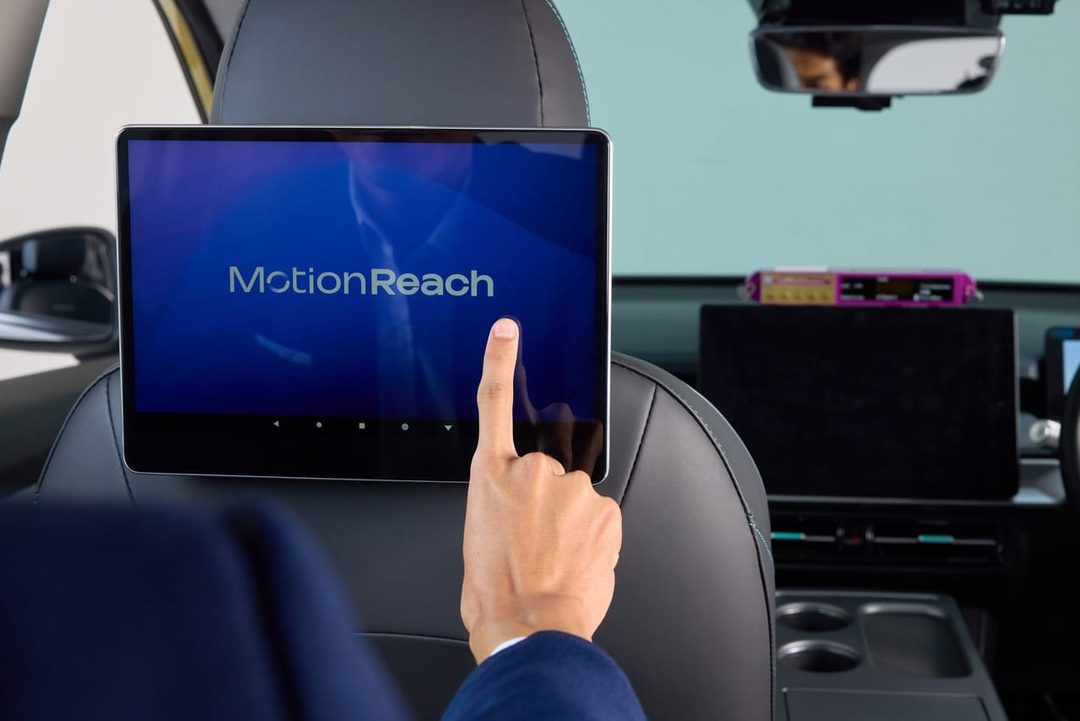
A digital screen CMS does three jobs: scheduling, swapping creative and logging plays. For in-store signage, the CMS is mainly about convenient updates. For DOOH it has to do more, because the brand paying for the airtime wants proof that the ad actually ran.
On the MotionReach taxi digital screen network, the MotionVision CMS records every play with GPS position and time, so it can report where and when an ad ran and target by route, zone or time of day. In the results report, one impression is counted per play, while reach and frequency are estimates derived from the play data.
An example of CMS data in use is Osotspa’s Hangster campaign from January to May 2026. The osotspa hangster taxi advertising case study records 8.24 million impressions from verified plays and 2.27 million unique passengers, an average frequency of 3.62. In-store screens rarely need to report at this level, but it is the standard an out-of-home buyer should expect.
In-store screens and out-of-home media do not compete; they work at different points of the customer journey. These signs suggest it is time to put the brand on screens outside the store.
If any of these apply, an easy start is a screen you can target by area, such as taxi screens set to zones around a branch or the routes your audience uses, with a QR code to a landing page. You then see both verified plays and audience response in one report.
The creative also has to change when you move from in-store to out-of-home. In-store screens speak to people who already intend to buy, so they can carry prices, promotions and menus. Out-of-home screens speak to people who are not thinking about the brand yet, so the creative must stop the eye in a few seconds: one clear message, a visible logo and a next step, such as a QR code or the nearest branch.
| Situation | Start with | Why |
|---|---|---|
| Raise basket size from shoppers in store | In-store digital signage | The audience is already at the point of sale |
| New branch that the neighbourhood should know | DOOH targeted to zones around the branch | Reaches people who have never visited |
| New product launch across Bangkok | Several DOOH formats together | Wide awareness in a short time |
| Mainly online sales | DOOH + QR to a landing page | Response can be measured on mobile |
For brands that want to extend to a roadside digital billboard or other moving formats, start from the full range of out of home advertising in Bangkok and plan the network so every screen tells the same story.
The screen technology is similar, but the purpose differs. Digital signage is the venue owner’s screen for people on site. DOOH is media that sells airtime to outside brands and needs proof-of-play and reporting for the media buyer.
If you install it yourself, cost comes from the screens, media players, installation, CMS licences and content production. Buying DOOH needs no hardware investment: you pay for media by area, duration and format, and creative production is usually quoted separately.
At minimum: scheduling, central creative changes, verifiable play logs and impression reports per ad. For moving screens, it should also record the GPS position of every play.
If customers already come in and you want a bigger basket, start with in-store digital signage. If the problem is that people do not know the store yet, start with DOOH targeted to zones around it, so budget reaches people nearby who might actually walk in.
Want your brand on screens beyond your own store? See the MotionReach DOOH network and get a media plan suited to your goal.
Sources: WOO 2026 Global Out of Home Expenditure Report (via invidis) · Hangster campaign figures from the MotionReach case study page.