

What is DOOH? DOOH is Digital Out-of-Home: advertising on digital screens outside the home that can change creative instantly, be scheduled and targeted by location, and log every play as proof. In 2025, DOOH was about 47% of global out-of-home spend, according to WOO (July 2026).
If a traditional billboard is a large poster that stays the same all month, DOOH is a sign that can “think”: it changes the message between morning and evening, plays only in the districts you choose and sends people on to their phones with a QR code. This article explains how DOOH works, the main types and what brands in Thailand should prepare before starting.
DOOH stands for Digital Out-of-Home and means advertising shown on digital screens outside the home, such as roadside LED screens, screens in train stations and screens inside taxis. Unlike printed out-of-home, creative can be changed instantly, scheduled by time, and measured by how many times it played, where and when.
DOOH is therefore part of out-of-home (OOH), not a separate medium. If you are not sure what out-of-home covers, start with the basics in our article what is ooh.
Terms worth knowing before you read on:
Both reach people outside the home, but they differ in how the ad is displayed and how flexible it is. The table summarises the main differences.
| Point | Printed OOH (static) | DOOH (digital) |
|---|---|---|
| Creative | Still image printed on material | Video or motion graphics on a screen |
| Changes | Reprint and reinstall | Upload new creative instantly |
| Timing | Same message 24 hours a day | Choose dayparts and rotate messages by time |
| Measurement | Estimated from footfall or traffic at the site | Proof-of-play logs, extendable with QR tracking |
| Production cost | Printing and installation every change | Digital files, no reprinting |
Use printed signs when you want to hold the same location for a long time, the message rarely changes and you want the brand to become part of the landscape, such as a large sign in front of a mall or on an expressway.
Use DOOH when the campaign needs speed and precision, such as weekly promotions, playing only in the morning before office hours, or playing only in the districts around your branches. Many brands use both: printed signs build recall, while digital screens deliver time-specific messages.
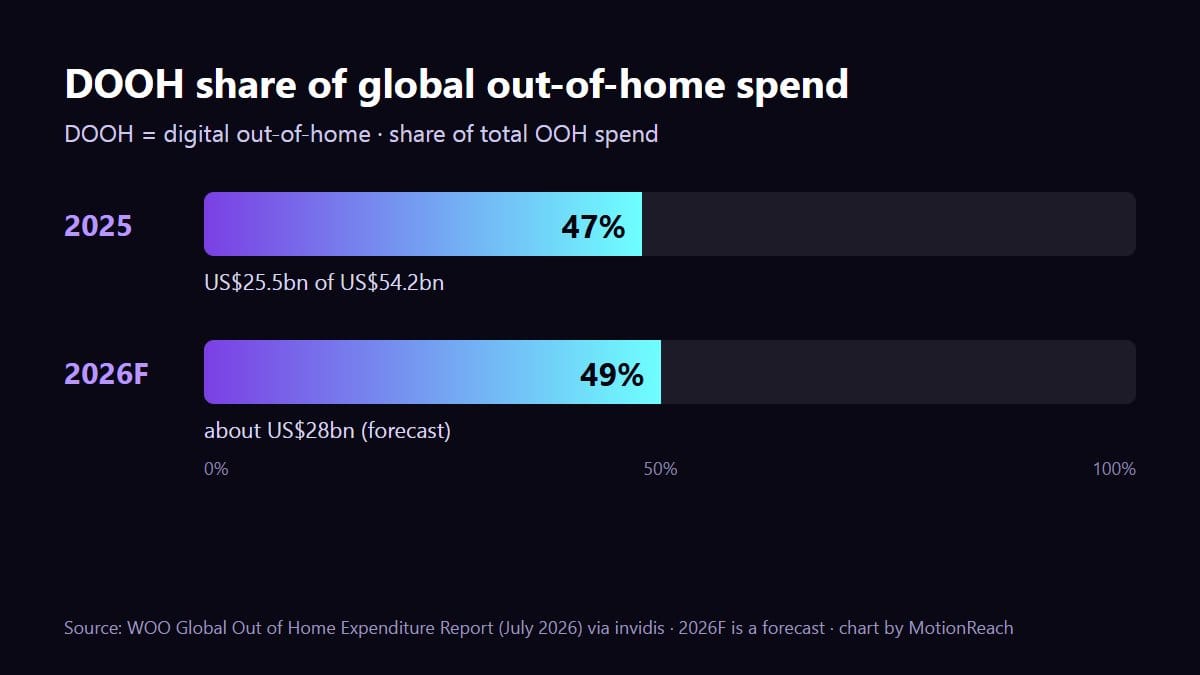
According to the WOO Global Out of Home Expenditure Report (July 2026), global out-of-home spend in 2025 was US$54.2bn, of which DOOH was about US$25.5bn, or about 47%. WOO expects the share to rise to about 49% (around US$28bn) in 2026.
In the United States, the OAAA reported on 18 August 2026 that Q2 2026 OOH revenue was US$3.16bn, up 10.7%, and that DOOH accounted for 38.4% of OOH revenue in that quarter.
There are three main reasons DOOH is growing quickly. First, brands want the flexibility of digital media in the physical world. Second, proof-of-play makes it easier for marketing teams to justify budgets to management. Third, screens connect to mobile through QR codes, so out-of-home no longer ends at visibility.
DOOH can be grouped by where the screen is and how the audience behaves. In a city like Bangkok there are four main groups.
Large screens along main roads, expressways and major junctions, suited to broad awareness. Most viewers are in vehicles or on the move, so creative should be short, low on text and readable in a few seconds.
Screens in stations, on platforms and in terminals reach regular city commuters and air travellers. Viewers have short waiting times, so creative can tell slightly more of a story than roadside screens.
Screens in shopping centres, office buildings and lifts sit close to the point of purchase or everyday routines, suited to promotions that aim for an on-the-spot decision.
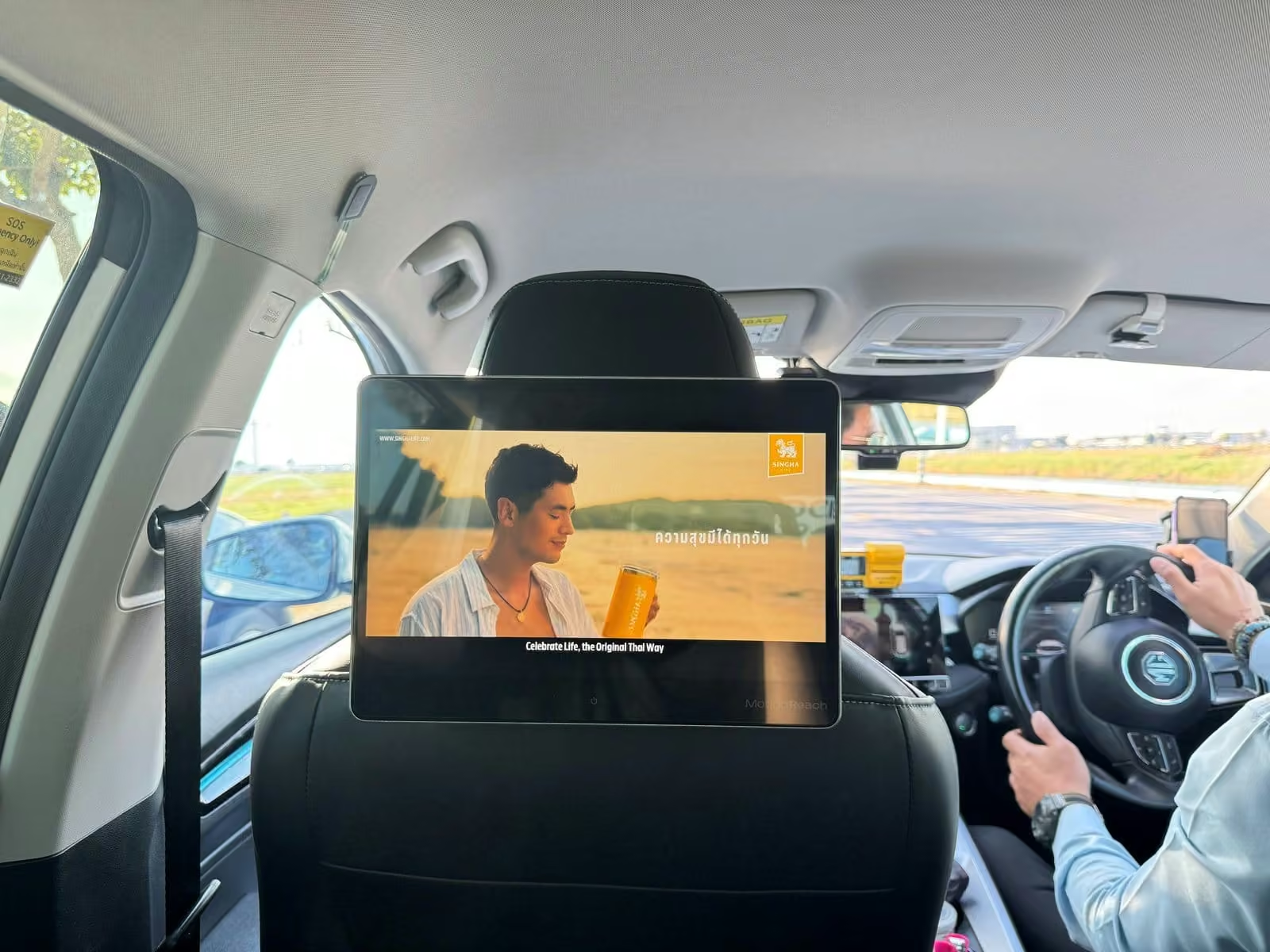
DOOH does not have to stay in one place. In-taxi digital screens play 30-second videos to passengers in the cabin, with route, zone and time selection, while car-top LED signs play 15-second creative to people on the street and can be bought as a network buy or a short Event Burst.
In-car screens are not new in Thailand; they have existed since 2005. What has changed is location targeting and play reporting, which turn taxi digital screen advertising into DOOH that travels to the audience instead of waiting for them to pass by.
Good DOOH lets a brand choose who it meets: the zone (a district or a radius around a branch), the route (such as the airport route, business districts or tourist areas) and the time (morning, evening, night). For example, Babyface Clinic’s geo targeted taxi advertising bangkok campaign (April–June 2026) ran only on routes around three branches and delivered 1.91M impressions from verified plays, reaching 458K unique passengers at an average frequency of 4.2, according to the MotionReach Case Study Database (June 2026).
On in-taxi screens, every play is recorded with GPS coordinates and a timestamp, so reports can show where, when and how many times an ad played. Printed signs can only be estimated from passing traffic. Play logs mean impression figures can be traced back to real data.
Digital screens can easily carry a QR code or campaign code. Viewers scan through to a microsite, game, quiz or discount code, so brands can see what people did after seeing the ad, which is at the heart of connecting offline and online media.
Before buying digital-screen media, prepare these three things.
The three KPI levels are Delivery (did the ad actually play, from verified plays), Exposure (how much opportunity to see, from impressions calculated from plays) and Response (did anyone act, such as scanning a QR code or using a code). One play is not one person seeing it, and one scan is not a sale, so separating the three levels keeps reports honest.
The MotionReach team plans and sources media from in-car screens and car-top LED to roadside digital screens and transit media, with reporting through MotionVision. See our dooh bangkok service page for details.
DOOH stands for Digital Out-of-Home: advertising on digital screens outside the home, such as roadside LED screens, screens in train stations, screens in malls and screens inside taxis.
It is hard to compare directly, because price depends on location, number of screens, duration and buying model. Digital screens usually share playtime with other brands but save printing and installation costs when creative changes. The best approach is to request a comparison plan for your brand’s actual brief; our team will propose options to fit your budget and goals.
It is buying digital-screen media automatically against conditions such as time, location or audience. According to the WOO and PwC Global pDOOH Expenditure study (2026), global programmatic DOOH spend was about US$1.34bn in 2025. Germany has the highest programmatic share at 31.8%, the United States is the largest market at about US$545.5m, and Eastern Asia buys only 0.6% of DOOH programmatically.
At three levels: Delivery from play logs with GPS and time, Exposure from impressions calculated from verified plays, and Response from follow-up actions such as QR scans, microsite visits or code use. The measurement method should be designed before the campaign starts.
Want to try DOOH with route targeting and a report for every play? Talk to the MotionReach team and get the Media Kit to see screen formats and sample reports.