

OOH means out-of-home advertising: media that reaches people while they live, work and travel outside the home, such as billboards, transit media, vehicle media and digital screens. If you have asked what is ooh, the short answer is that it is one of the few channels that grew in Thailand in 2025, taking 17.7% of total ad spend according to MAAT (March 2026).
OOH stands for Out-of-Home. It covers every advertising format people see once they leave home, whether they are driving, riding in a taxi, waiting for the BTS or walking through a mall. In Thai it is usually called สื่อโฆษณานอกบ้าน, and in English the category is simply out of home advertising.
What sets OOH apart from online media is that people cannot skip or close it. Billboards and vehicle media sit in the real world, and people pass them again every day, so brands build recall through frequency and scale.
Looking at all the types of advertising, OOH is the group that lives in the physical world and works alongside TV, radio, print and online.
Out-of-home media falls into five main groups, based on where it appears and how it is displayed.
Large signs along main roads, expressways and landmarks are the oldest form of OOH. They suit broad awareness, because people who take the same route every day see them again and again throughout the campaign.
Media inside public transport, such as signs and screens on the BTS, MRT and at airports, reaches city commuters who travel every day. According to MAAT (March 2026), Transit was the fastest-growing category in 2025 at +22.7%.
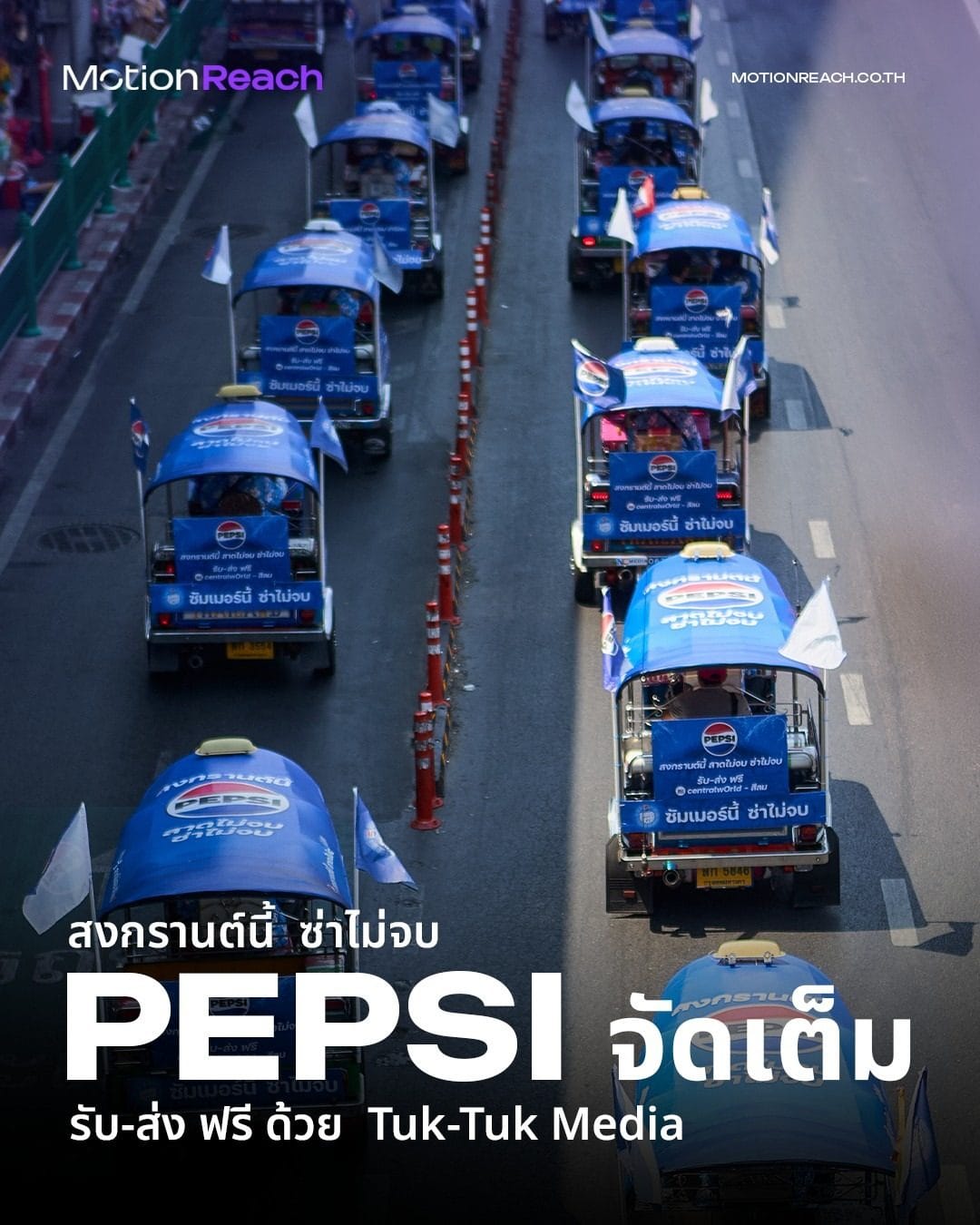
This is media that moves with cars and boats: full or half taxi wraps, bus exteriors and in-bus media, trucks from pick-ups to 10-wheelers, tuk-tuks in tourist areas and during festivals, and boats on the Chao Phraya River, including EV boats and LED boats. The advantage is that the media travels to people across many districts instead of waiting for them to pass a single spot.
One example from the MotionReach Case Study Database (June 2026) is Pepsi’s Songkran 2026 campaign, which used 20 fully wrapped tuk-tuks on a route from CentralWorld to Parq Silom from 13 to 15 April 2026. It delivered about 600K impressions (estimate), and 3,840 people actually rode the brand’s tuk-tuks.
For brands that want vehicle media working both outside and inside the cabin, taxi advertising can combine car wraps and a taxi digital screen in one plan.
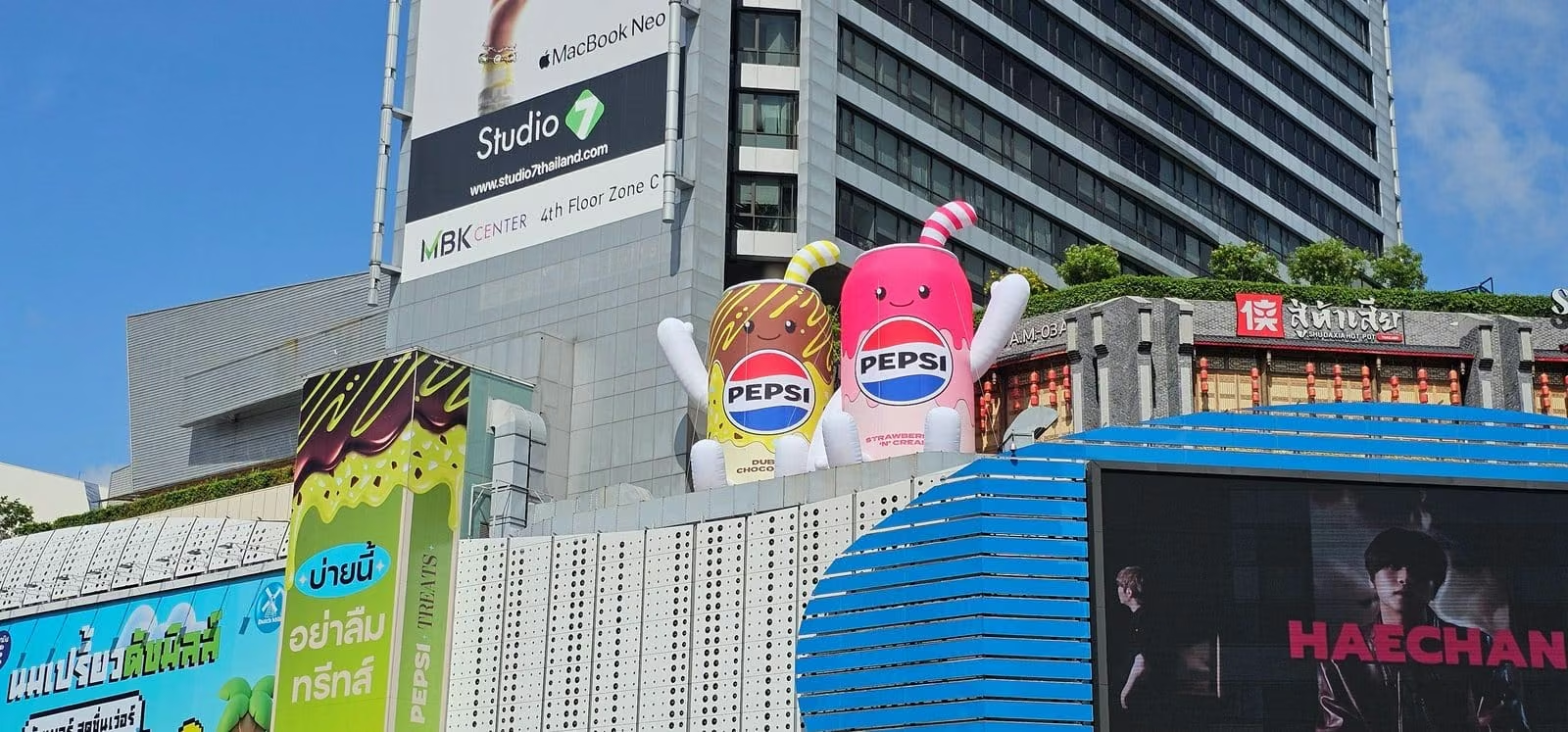
Some media is designed to make people stop, take photos and talk about it: giant balloons, landmark dressing or unusual use of roadside space. One example is Pepsi’s campaign at MBK Center, which paired a 7×15-metre balloon with a billboard for one month to launch two new flavours, reaching about 15M+ impressions (estimate), according to the MotionReach Case Study Database (June 2026).
DOOH is out-of-home media shown on digital screens. Creative can change instantly, airtime can be scheduled, and every play is logged. According to the WOO report (July 2026), DOOH made up about 47% of global out-of-home spend in 2025. The details are covered in our guide what is dooh and on our dooh bangkok service page.
MAAT data (March 2026) shows that Thai out-of-home (Outdoor + Transit) grew 13.5% in 2025 while the total ad market shrank 1%, and it held 17.7% of all ad spend, against a global average of 5.1% (WOO, July 2026). The full numbers are in our out of home advertising statistics article. Beyond the market figures, OOH has practical strengths:
Measurement is where OOH has changed the most. Out-of-home used to be judged only on estimated foot traffic, but a good report today separates three levels: Delivery (did the ad actually run or get installed), Exposure (how many people had the chance to see it) and Response (who did something next, such as scanning a QR code or using a code). The method has to be designed into the brief, not searched for after the campaign ends.
It is also worth knowing that OOH does not compete with online; the two work together. Out-of-home builds awareness and credibility in the real world, and online picks up when people search, scan or share. Campaigns that perform well usually plan the hand-off between the two from the start.
No single kind of mobility ooh bangkok media fits every campaign. Start with the goal, then pick the format. This table is a starting point.
| Campaign goal | Suitable media | Why |
|---|---|---|
| Broad awareness | Billboards, expressway signs, bus wraps | Large and seen daily on main routes |
| Target an area or branches | Taxi digital screens (by zone or route) | Plays only in the districts where the audience is |
| Make a launch go viral | Special media, balloons, landmarks | People stop, take photos and share |
| Get people to try the product | Cabin dressing, sampling trays, activations | The audience experiences the brand on the way |
| Reach tourists | Tuk-tuks, boat media, airport routes | Placed in the areas and routes tourists use |
| Drive action | Digital screens + QR / microsite | Moves people from the screen to their phone, measurably |
In practice, many brands combine formats: a car wrap for outside visibility, in-car screens to tell the story, and QR codes to measure who acts next. MotionReach plans and buys media across vehicle media, billboards, transit and special media under one plan and one report.
OOH stands for Out-of-Home, meaning advertising seen outside the home. It covers billboards, roadside signs, transit media, vehicle and boat media, special media and digital out-of-home screens.
There are five main groups: billboards and roadside signs, transit media, vehicle media, special or ambient media, and DOOH on digital screens. Each suits a different goal.
DOOH is the part of OOH shown on digital screens, so creative can change, be scheduled and have every play logged. Printed OOH shows the same image for the whole contract. Read more in our guide to DOOH.
It works for big brands and for businesses with branches in clear locations. The key is choosing the format and area that match the audience. A clinic with several branches, for example, might choose taxi screens on routes around its branches instead of buying billboards across the city.
Not sure which out-of-home media fits your brand? Let the MotionReach team help you plan. Get the Media Kit to see every format and campaign example.