

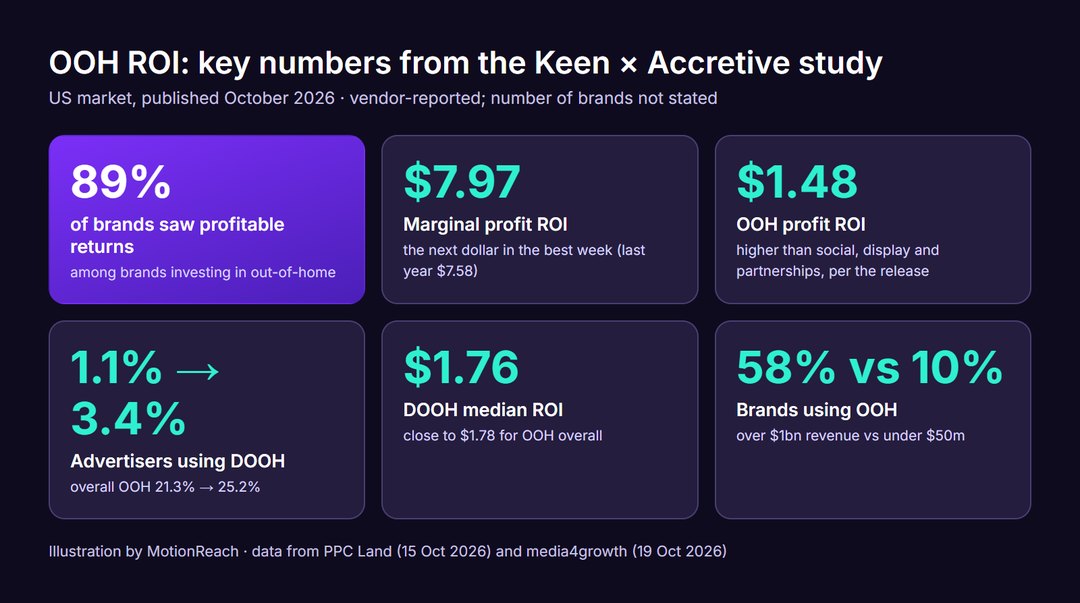
What is ROI in marketing? It is the return a campaign generates compared with what it cost, used to answer how much profit each unit of ad spend brings back. In October 2026 a US study by Keen Decision Systems and Accretive reported that 89% of brands buying out-of-home media saw a profitable return, and that marginal profit ROI rose to $7.97 from $7.58.
The numbers sound good, but both companies published them themselves and did not say how many brands were studied. This article explains the basics of ROI, what each figure means and how brands can measure the return on their own campaigns, from the media-planning side at MotionReach.
ROI stands for return on investment. The basic formula is (return − cost) ÷ cost × 100, giving a percentage. A positive result means you got back more than you spent.
Example: a brand spends 100,000 baht on advertising and the campaign adds 150,000 baht of gross profit. ROI = (150,000 − 100,000) ÷ 100,000 × 100 = 50%. The key is to use profit, not sales, and to separate the profit that really came from the campaign.
| Metric | Calculated as | Answers |
|---|---|---|
| ROI | (return − cost) ÷ cost | How much profit did the investment return? |
| ROAS | sales ÷ ad spend | How much revenue did each unit of ad spend bring? |
| Marginal ROI | return on the next amount added | If we add budget, how much more do we get? |
Keen Decision Systems is a marketing-mix SaaS platform; Accretive is an out-of-home data and technology company. The data covers the US market and was reported by PPC Land (15 October 2026) and media4growth (19 October 2026).
The easiest figure to remember is $7.97, but it has to be read correctly. The release defines marginal ROI as what the next dollar spent will return in the most optimal week for investment. It is a best-case planning number, not the average return on the whole budget.
Looking at the budget as a whole, the same study reports a profit ROI of $1.48, far lower. The two answer different questions. PPC Land also notes that the high marginal figure partly reflects how small most brands’ OOH budgets still are, which keeps them on the steep part of the response curve; if budgets grew a lot, the figure might not hold.
The share of advertisers using digital out-of-home screens rose from 1.1% to 3.4% in one year. The base is still small, but it shows online-first brands starting to test screens outside the home, because creative changes quickly, airtime can be scheduled and measurement connects more easily to digital tools.
Even so, the median ROI of digital screens ($1.76) is close to OOH overall ($1.78). On this data, digital is not clearly more profitable than static; the difference lies in flexibility and measurement.
There is no need to wait for research from abroad. Brands can measure their own campaigns if it is planned from the brief.

An example of media built to capture response from the start is TikTok Shop’s 6.6 Mega Sale on MotionReach interactive dooh advertising bangkok in June 2026. Passengers played a birthday fortune game on the in-taxi touchscreen and received a discount code on the spot. The 30-day campaign recorded 735,000 verified impressions from 290,000 unique passengers, an average frequency of 2.53.
The best-looking figure is often marginal ROI. Always look at the average return, the method and who did the research.
If your brand only buys online, set aside part of the budget to test out of home advertising, measured with QR codes, promo codes or branded search, to see real results in your market, and write the metrics into the media plan from the start.
Screens bought through dooh bangkok can carry a QR code people scan straight away, and taxi digital screen formats let passengers tap during the ride while every play is logged.

ROI measures profit against the investment; ROAS measures revenue against ad spend. A high ROAS can still lose money if product costs are high, so budget decisions should also look at ROI.
There is no single figure for every brand. It depends on product margin and campaign goals. Set targets as metrics you can really measure, such as scans, code redemptions or lift in recall.
Yes. Screens in EV taxis can be tapped or scanned, so response data is collected straight away, and every play is logged. Pair them with discount codes or surveys to measure further.
It depends on the goal. Immediate response such as scans shows from the first week, while brand recall needs people to see the ad repeatedly over time. Agree the measurement window with the planning team at the start.
Want out-of-home media you can actually measure? Get the MotionReach media kit and let the team plan the media, QR codes and reporting with you.
Sources: PPC Land (15 Oct 2026) · media4growth (19 Oct 2026) · TikTok Shop figures from the MotionReach case study page · infographic by the MotionReach team