

In 2025, out-of-home (OOH) advertising in Thailand grew 13.5% and was the fastest-growing medium, while the total advertising market shrank 1%, according to MAAT’s 2026 Media Industry Update (March 2026). MAAT expects OOH to take about 19.6% of the country’s advertising spend in 2026.
In April 2020, the Thai podcast Mission To The Moon asked whether COVID would change the billboard game. Six years later, the data gives a clear answer: out-of-home did not die. It came back bigger, and its job shifted from simply being seen to getting people to try and act. This article collects the key out of home advertising statistics marketers should know before planning a 2026 budget.
According to MAAT (the Media Agency Association of Thailand) report of 31 March 2026, Thailand’s advertising market fell from ฿116,620 million to ฿115,443 million in 2025, a 1% decline. Outdoor and Transit media together, however, grew 13.5% against the market.
Put simply, the advertising money did not disappear. It moved, and the place it moved to most was out of home advertising. Three numbers are worth remembering.
A note on definitions: the 13.5% figure counts only Outdoor + Transit. If in-store media is included, as in MAAT’s own definition, growth is 12.9%.
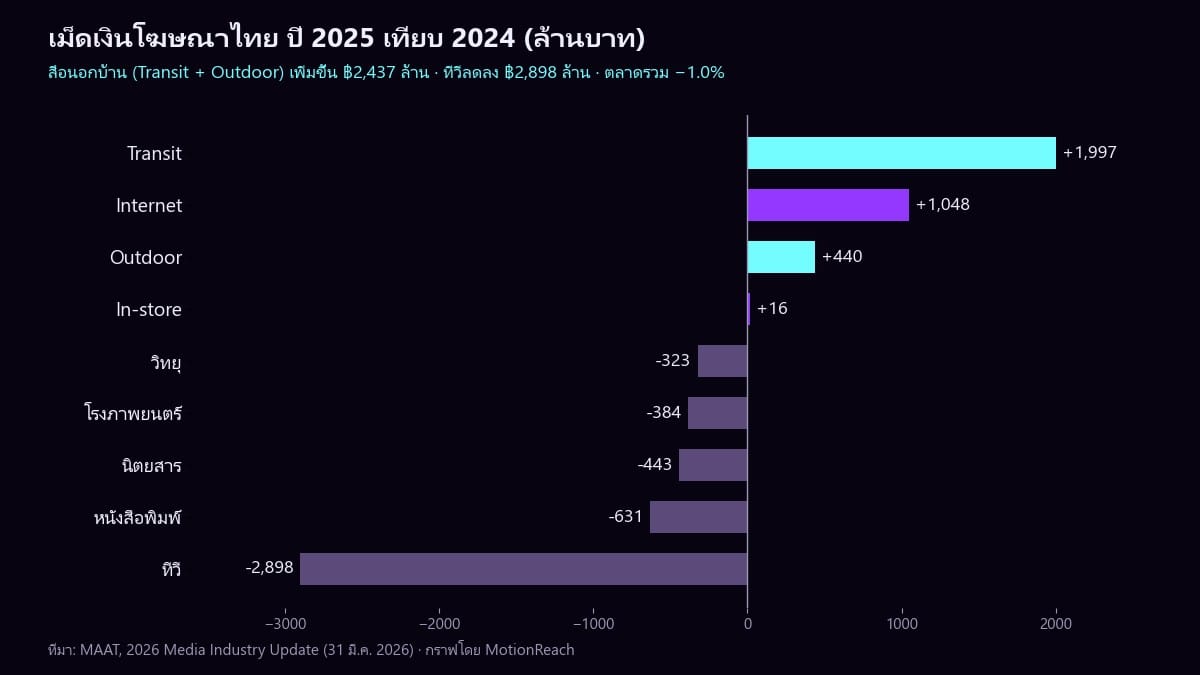
MAAT data (March 2026) shows that in 2025 TV lost ฿2,898 million, while Transit and Outdoor together gained ฿2,437 million. The table below summarises each medium’s gain or loss compared with 2024.
| Medium | Change (฿ million) | Change (%) |
|---|---|---|
| Transit | +1,997 | +22.7% |
| Internet | +1,048 | +2.9% |
| Outdoor | +440 | +4.8% |
| In-store | +16 | +1.7% |
| Radio | −323 | −9.9% |
| Cinema | −384 | −10.6% |
| Magazines | −443 | −65.1% |
| Newspapers | −631 | −50.8% |
| TV | −2,898 | −5.5% |
| Total market | ฿116,620 million → ฿115,443 million | −1.0% |
Source: MAAT, 2026 Media Industry Update (31 March 2026)
Why look at baht and not only percentages? Percentages distort the picture easily. Magazines fell 65.1%, which sounds the most dramatic, but only ฿443 million disappeared. TV fell just 5.5% yet lost almost ฿2,900 million. Baht shows more clearly where brands really moved their budgets.
The usual follow-up question is whether out-of-home grew only because prices rose. MAAT (March 2026) puts OOH media inflation at about 8% in 2025, while Transit grew 22.7%, far above media inflation. The growth therefore did not come from price alone; brands genuinely bought more media.
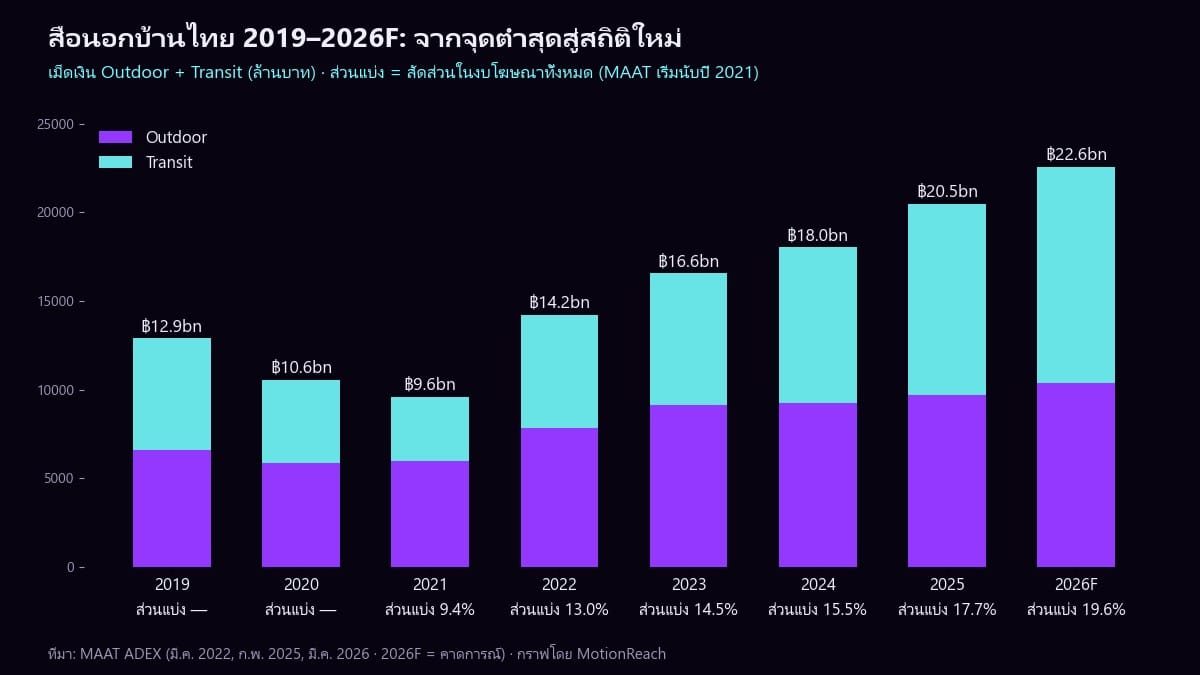
MAAT’s historical ADEX tables show that Thai out-of-home (Outdoor + Transit) fell to only ฿9,610 million in 2021, then rose to ฿20,474 million in 2025. That is 2.1 times the low point and about 59% larger than pre-COVID 2019.
| Year | Outdoor (฿ million) | Transit (฿ million) | Total OOH (฿ million) | Share of total ad spend |
|---|---|---|---|---|
| 2019 | 6,610 | 6,282 | 12,892 | — |
| 2020 | 5,842 | 4,726 | 10,568 | — |
| 2021 | 5,999 | 3,611 | 9,610 | 9.4% |
| 2022 | 7,837 | 6,394 | 14,231 | 13.0% |
| 2023 | 9,116 | 7,438 | 16,554 | 14.5% |
| 2024 | 9,237 | 8,800 | 18,037 | 15.5% |
| 2025 | 9,677 | 10,797 | 20,474 | 17.7% |
| 2026F | 10,355 | 12,200 | 22,555 | 19.6% |
Sources: MAAT ADEX reports March 2022 (2019–2020), February 2025 (2021–2023) and March 2026 (2024–2026F, “more likely” scenario)
Within four years, out-of-home’s share of Thai advertising spend almost doubled, from 9.4% in 2021 to 17.7% in 2025, according to MAAT (March 2026). MAAT expects it to reach 19.6% in 2026, forecasting OOH growth of 10% while online moves −0.3% and TV −4%. These are forecasts as of March, not actual results.
From another angle, the Bangkok Post cites MI Group’s forecast that Thai out-of-home spend will be about ฿17.9bn in 2026 according to the Bangkok Post. That figure uses a different definition and base from MAAT, so the two should not be compared directly.
MAAT changed how it counts TV and online spend after 2020, so total-market figures before 2021 cannot be compared with later years. The share column therefore starts in 2021, while the OOH spend line itself can still be compared across years.
The same trend is happening worldwide. According to the WOO Global Out of Home Expenditure Report (July 2026), global OOH spend reached US$54.2bn in 2025, 5.1% of worldwide advertising spend, and about 47% of OOH spend went to digital screens (DOOH).
In the United States, the OAAA reported on 18 August 2026 that Q2 2026 OOH revenue reached US$3.16bn, up 10.7% and above $3bn in a quarter for the first time, with Transit the fastest-growing format at +23.9%.
Among global players, JCDecaux’s full-year 2025 results (12 March 2026) report revenue of €3,967.1m, above 2019’s €3,890m, even though revenue had dropped about 41% in 2020. Digital accounted for 41.7% of revenue.
By share, out-of-home was 17.7% of Thai advertising spend in 2025 (MAAT, March 2026), against a global average of 5.1% (WOO, July 2026), roughly 3.5 times higher. The two sources define OOH slightly differently, so the safe conclusion is this: Thailand is not a market that is still unconvinced by out-of-home. It is one of the markets that uses OOH most heavily.
Nielsen IMS data presented by MAAT (March 2026) shows Thai Gen Y spending 7 hours 8 minutes a day on screens, Gen Z 6 hours 49 minutes and Gen X 5 hours 8 minutes. A mobile feed can be skipped; the street cannot. Out-of-home is a channel that does not have to fight for space with content in the feed.
According to WOO (July 2026), about 47% of global OOH spend in 2025 was DOOH. Digital screens let brands choose the time, place and content, and connect straight to mobile with a QR code. If this format interests you, see our dooh bangkok service for details.
OAAA research with The Harris Poll (17 September 2026, n=2,015) found that 86% of US respondents take an action after seeing a retailer’s OOH ad: 45% visit a website or app, 42% search for information and 33% go to the store. This is US data, so treat it as a trend signal rather than a figure for Thai consumers.
In MAAT’s data (March 2026), Transit was the fastest-growing category of any medium in 2025 at +22.7%, and MAAT expects Transit to reach ฿12,200 million in 2026, more than Outdoor at ฿10,355 million.
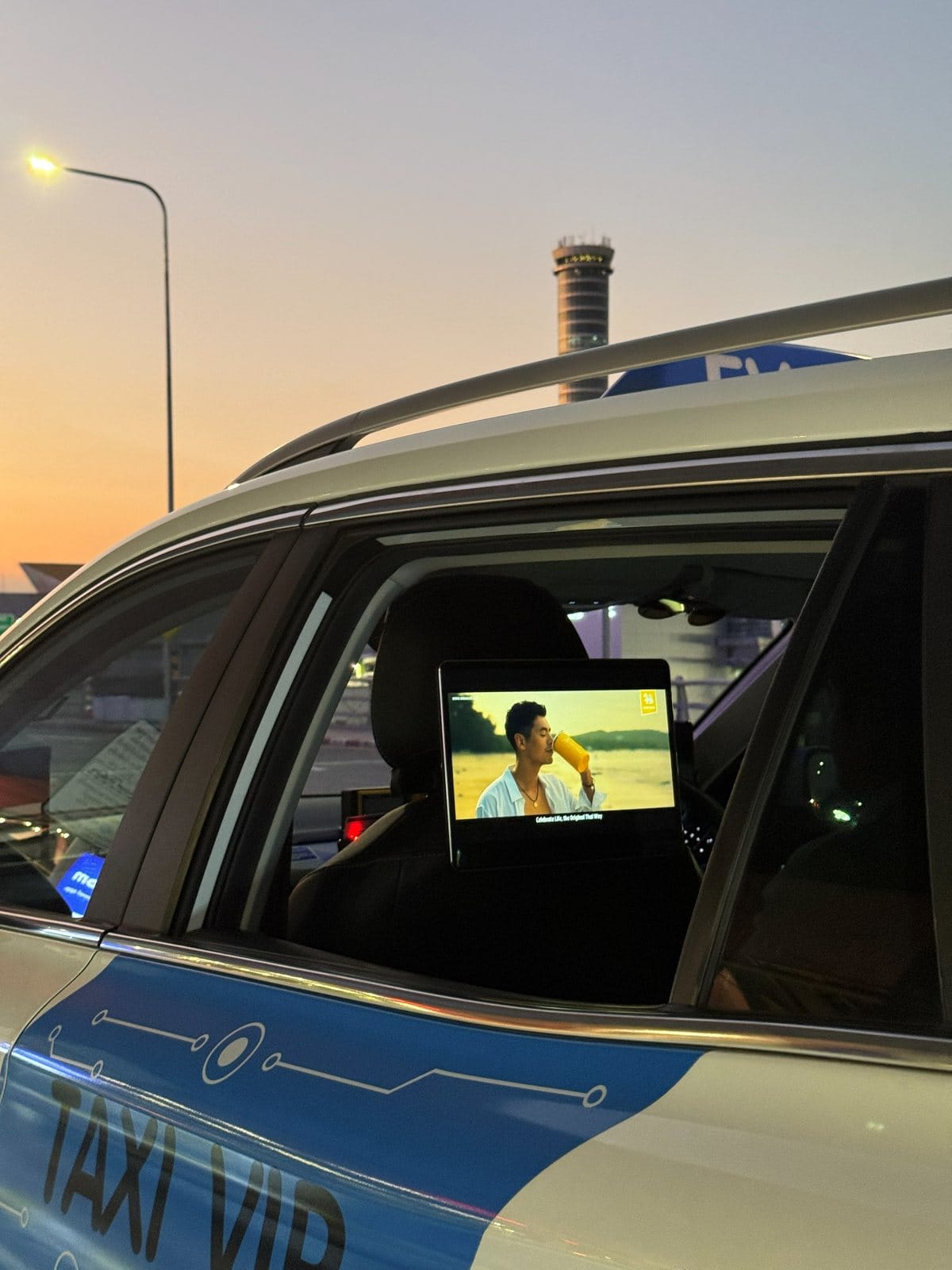
Transit is not only signage in train stations. It also includes mobility ooh bangkok formats that travel with city residents, on taxis, buses, tuk-tuks and boats. The advantage is that a brand does not wait for people to pass one spot; it meets people across many districts throughout the day.
MotionReach plans and sources both moving and fixed-location media, for example:
For brands that want to start with media where the audience sits with a screen during the journey, taxi advertising is a starting point that combines outside visibility with storytelling inside the cabin.
The numbers say out-of-home is growing, but simply buying more signs is not enough. Before briefing your next out-of-home campaign, answer these four questions.
If you can answer all four, the campaign will not end at visibility; it will return data that becomes the brief for the next one.
OOH stands for out-of-home: advertising that reaches people while they are away from home, such as billboards, transit media and vehicle media. For a detailed explanation, read our article what is ooh and how many types there are.
In March 2026, MAAT forecast that Thai out-of-home will grow about 10% in 2026 and take 19.6% of total advertising spend, while TV is expected to fall 4%. These are forecasts, not actual results.
Online ads sit in feeds that users can skip or block. Out-of-home sits in real places people pass every day; it cannot be closed and is seen repeatedly. The two work together, especially when a QR code or promo code takes people from the sign to their phone.
Yes, if measurement is designed in from the brief. A good report separates three levels: Delivery (did it actually play), Exposure (how much opportunity to see) and Response (who did what next, such as scanning a QR code or using a code). Agree how each level will be measured before the campaign starts.
Seen the numbers? To find out which out-of-home format fits your brand, get the Media Kit from MotionReach and let our team plan everything from routes and media to measurement.